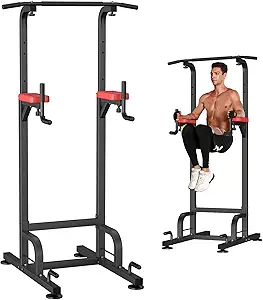
I tried doing dips between two kitchen chairs once. One slid, I caught myself on the counter edge, and my wife banned all future chair-based exercises. Fair. But dips are one of the best upper body exercises for chest and triceps, and I didn’t want to give them up just because my improvised setup was dangerous.
A freestanding dip station solved it properly. Heavy steel base, padded grips, stable enough to add a weighted vest without wobbling. I put it in the garage next to my bench, and it handles dips, leg raises, and knee tucks without any furniture-based risk-taking.
The Heavy-Duty Dip Tower Built for Home Gym Use
This is one of Amazon’s top-rated freestanding dip stations in the $80–$200 range — featuring a heavy-gauge steel frame, padded arm rests, non-slip grip handles, and a weight rating of 350–500 lbs for loaded dips.
What separates a stable dip station from a wobbly one:
– Wide base footprint — narrow bases rock laterally during dips, especially when you add weight
– Heavy-gauge steel frame — thin tubing flexes and creates a bouncy, unsafe feel at the top of each rep
– Padded arm rests and grip handles — bare steel causes forearm bruising during leg raise holds
– 350+ lb weight rating — your body weight plus a 40-lb weighted vest needs to be well within the frame’s capacity
– Rubberized feet — prevents sliding on concrete, tile, or hardwood without damaging the floor
Freestanding Dip Station vs. Wall-Mount vs. Power Tower
Each dip station format fits different spaces and budgets:
– Freestanding station: no installation, moveable, moderate footprint — ideal for garages and spare rooms
– Wall-mount dip bars: smallest footprint, very stable, but requires wall studs and permanent installation
– Power tower (dip + pull-up combo): most exercises in one unit, but larger footprint and higher price
– For a garage gym where the station shares space with a car, a freestanding unit that can be moved aside is the most practical choice
Dips complement pressing exercises perfectly — together with bench press and push-ups, they complete your upper body pushing movement library. The budget flat bench guide covers the bench side of the equation for a balanced pressing setup.
Before vs. After the Dip Station
Before:
– Tricep work limited to kickbacks and overhead extensions with dumbbells — effective but incomplete
– No hanging ab work possible — floor-based core exercises only
– Improvised dip setups with chairs were unstable and genuinely dangerous
– Upper body pushing program felt incomplete without a vertical pressing/dipping movement
After:
– Dips added as a primary upper body push exercise — chest and tricep development noticeably improved
– Hanging leg raises and knee tucks added a core exercise dimension floor work couldn’t match
– Progressed from bodyweight to weighted dips within 6 weeks — clear strength gains from a single piece of equipment
– Station is heavy enough to feel secure but moveable when I need the garage space
5 Tips for Effective Dip Station Training
– Lean forward slightly for chest emphasis, stay upright for tricep emphasis — body angle determines which muscles do the most work.
– Lower until your upper arms are parallel to the floor, no deeper — going too deep puts excessive stress on the shoulder capsule.
– If you can’t do a full dip, start with negatives — jump to the top position and lower yourself as slowly as possible. Five slow negatives build the strength for full reps quickly.
– Add weight with a dip belt or weighted vest once you can do 3 sets of 12 bodyweight dips — progressive overload applies to dips just like any other exercise.
– Alternate between dips and push-ups within a workout — they hit similar muscles from different angles and the variety prevents overuse strain.
For a full upper body program that integrates dips with pull-ups and pressing, the home gym beginner equipment guide covers how to structure a complete training week with minimal equipment.
Q&A: Dip Station Questions People Search For
Q: Are dips safe for your shoulders?
Dips performed with controlled depth and proper form are safe for healthy shoulders. Dropping too deep or flaring elbows wide increases shoulder stress. If you have existing shoulder issues, start with bench dips (feet on the floor) and progress gradually.
Q: How much floor space does a freestanding dip station need?
Most freestanding stations occupy roughly 3×2 feet of floor space. You need additional clearance on the sides for your body during leg raises. Plan for about 4×3 feet total usable space.
Q: Can I do pull-ups on a dip station?
Not on a standard dip station — the bars are at waist height. A power tower combines dip bars and a pull-up bar. If you want both exercises, consider a power tower or pair a dip station with a separate doorway pull-up bar.
Q: What’s the difference between dips on a station vs. ring dips?
Station dips are fixed and stable — good for building strength and adding weight. Ring dips are unstable and require significant core and shoulder stability. Master station dips first before attempting ring dips.
Final Take
A freestanding dip station adds two of the best bodyweight exercises — dips and hanging leg raises — to a home gym for under $150. It’s the piece that fills the gap between bench pressing and push-ups, providing a vertical pushing option that develops chest and triceps in a way no other home exercise matches.
Heavy base. Stable frame. Dips without the chair disaster.
Dip it. Hang from it. Upper body complete.
Affiliate disclosure: This article may contain affiliate links. If you purchase through them, HomeGymStarter.com may earn a small commission at no additional cost to you.